
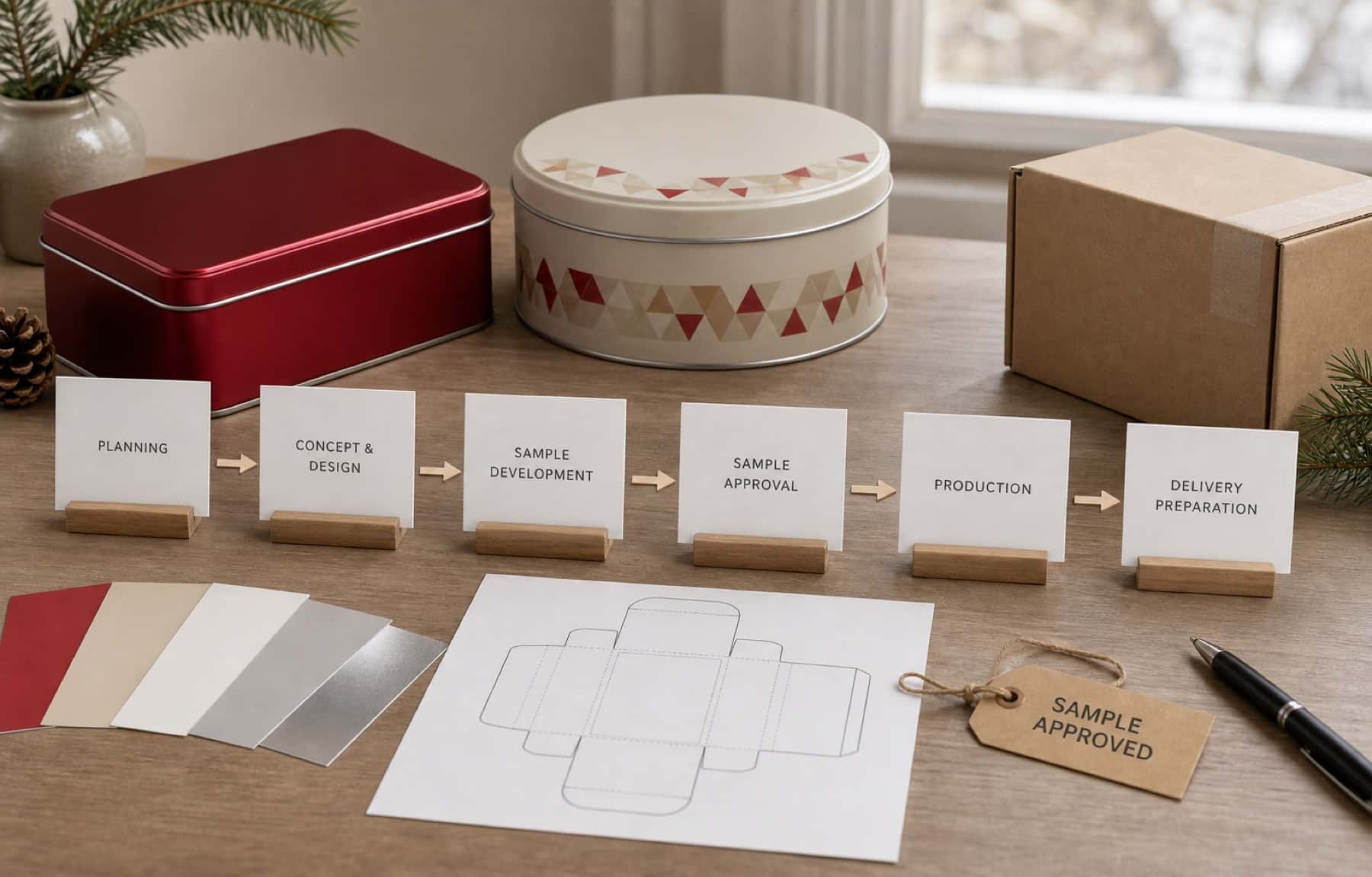
Plan Christmas tins backwards from the date finished goods must arrive—not from the factory production date. Separate product and structure approval, new tooling, artwork, sample revisions, mass production, export packing, transport and delivery buffer. Junmei can align production capacity with an annual purchasing cycle, but no fixed seasonal deadline is reliable until the specification and approvals are known.
Build the schedule around the required arrival date
Start with four dates:
- Required arrival date: when the tins or filled product must be available at the warehouse, retailer or campaign location.
- Latest shipping date: calculated from route, mode, customs, inland delivery and an appropriate buffer.
- Factory completion date: when packed tins must pass inspection and be released for shipment.
- Approval deadline: when structure, artwork, sample and order conditions must be complete to protect the production window.
Do not combine these into one “delivery time.” Junmei manufactures and packs the tins; transit, customs, filling and retail distribution may be controlled by different parties.
Practical Christmas tin workback plan
| Phase | Main decisions | What can extend the phase |
|---|---|---|
| 1. Product and project brief | Product, fill arrangement, quantity, designs, market, budget priorities and arrival date | Missing product sample, unclear capacity or multiple stakeholder approvals |
| 2. Tin and mold selection | Existing format versus new tooling, lid, insert, usable dimensions and packout | Proprietary size, special shape, new closure or tooling revisions |
| 3. Artwork and prepress | Dieline, copy, colors, finishes, emboss/deboss and version matrix | Late translations, barcode/legal changes or many artwork variants |
| 4. Sampling and testing | Fit, print, finish, coating, lid, insert, packing and agreed functional checks | Sample revisions, third-party tests or changed product/inner pack |
| 5. Production | Material, printing/coating, cutting, forming, assembly, QC and packing | Complex processes, unusually large quantities or late release |
| 6. Freight and delivery | Booking, export documents, loading, customs and inland delivery | Route congestion, inspections, weather and buyer/importer documentation |
The schedule should have a named owner and approval date for every phase. “Awaiting feedback” is not a buffer.
Existing molds protect time; new tooling needs its own plan
An existing round, rectangular, square or special-shape format can shorten development because the main structure is already established. Junmei reviews existing molds first and can recommend nearby dimensions based on product fit and packout.
New tooling may be appropriate for a proprietary size, distinctive shape, functional feature or long-term program. It requires feasibility review, tool manufacture, trials and possible revisions. Do not hide this work inside the sample lead time. Confirm the tooling route before final artwork is placed on the dieline.
Review the tin shape and size guide before fixing a seasonal format.
Artwork version control is a seasonal risk
Christmas programs often use multiple designs, languages, gift sets or retailer versions. Provide a version matrix showing SKU, artwork name, quantity, barcode, market and approval status. A shared total quantity does not remove the production implications of many separate artworks.
Junmei frequently supports seasonal multi-artwork programs, later repeat orders and color/version control against approved samples or color references. The buyer remains responsible for final copy, translation, claims and barcode data. Use the artwork preparation checklist to prevent late prepress changes.
Use published lead times as planning references, not guarantees
Samples are usually completed in 3–7 working days after the necessary specification and artwork are confirmed. Bulk production is typically about 25 days after required sample/artwork approval and order confirmation. These are planning references, not fixed promises. New tooling, sample revisions, multiple designs, special finishes, quantity and factory capacity can extend the plan; shipping time is additional.
Junmei’s starting MOQ for custom production is 3,000 pieces, with the final MOQ depending on size, structure, printing and tooling. Payment is normally 50% deposit and balance before shipment, subject to the final pro forma invoice or contract.
Plan sampling and transit validation before mass production
The seasonal sample should be approved for product fit, lid operation, print, color, emboss/deboss, insert, coating and packing. If the tin protects delicate cookies, chocolates, gift components or a multi-layer arrangement, define the tray, divider, liner, headspace and outer-carton protection together.
Junmei can support project-specific sealing, drop or vibration tests. Chocolate temperature control and final product stability remain the responsibility of the brand, filler or logistics provider. A transport test should represent the approved carton configuration and route risk.
Protect repeat orders and annual capacity
For recurring Christmas programs, preserve the approved artwork, physical sample, color/finish reference, mold identity, material/coating specification, insert and packing instructions. Review changes before each order. Junmei can plan capacity around a customer’s annual purchasing cycle when forecasts and approval windows are shared early.
The repeat-order reference pack guide provides the control list. Buyers can also review Junmei’s Christmas tin options and broader holiday packaging solutions.
To build a project-specific workback schedule, send the product, quantity per design, artwork status, mold preference, destination and required arrival date through the RFQ page. Junmei will separate approval, production and transport assumptions before confirming timing.